
How to Choose a Custom Software Development Company
Choose on evidence you can check: relevant work, a clear process, code ownership, review cadence and how problems are handled. Ten questions to ask.
A custom software development company designs, builds and maintains software around your specific workflow instead of selling a ready-made product. The best way to choose one is on evidence you can check: relevant work, a clear process, who owns the code, how progress is reviewed and how problems are handled. Ask for a scoped plan before a price.
What does a custom software development company do?
It takes a business need, shapes it into a scope, designs and builds the software, tests it, releases it and usually supports it afterwards. Some firms specialise in one kind of product; others cover web, mobile, integrations and AI. What matters is whether the work they have done resembles yours.
Which ten questions should you ask?
Put these to every supplier in writing, and compare the answers side by side.
- Process: how does a project move from idea to release, and what do I receive at each stage?
- Ownership: who owns the code, designs and data, and what do I receive at handover?
- Review: how often will I see working software, and who decides that a milestone is accepted?
- Team: who will work on my project, and can I speak to them directly?
- Relevant work: which past projects resemble mine, and what can you show of them?
- Security and access: who has access to my systems and data, and how is that access removed afterwards?
- Support: what happens after release, and how are fixes and changes handled?
- Scope change: how are new requests priced and approved?
- References: can I speak to someone who has worked with you, or read reviews on an independent site?
- Tooling: which tools and repositories will we share, and can I keep using them without you?
How should you read case studies and reviews?
A case study shows what a supplier built. It does not prove what the software achieved unless it states a measured result and where the number comes from. Look for the problem, the decisions made, who was involved and the outcome. Treat unnamed clients and unsourced figures with the caution you would give any claim.
Independent review sites help, but read the reviews themselves and not only the rating.
What red flags should make you ask more questions?
None of these proves a problem. Each is a prompt to ask more.
- A price with no scope: what exactly does it include?
- A fixed delivery date before any discovery: what assumptions sit behind it?
- No mention of testing or handover: how is quality checked and knowledge transferred?
- Reluctance to say who will do the work: who are they, and where are they based?
- Guarantees of outcomes the supplier does not control, such as rankings or revenue: what evidence supports them?
How does Cubusify answer these questions?
Using only what is published on this site: Cubusify agrees milestones and commercial terms before development begins. The project agreement defines ownership and handover, and the agreed code, designs and project assets are handed over to you. Cubusify is based in Surat, India and works with clients worldwide. Our case studies describe the supplied screens and project briefs behind each piece of work, and the site states that figures in screenshots are not claims of measured business performance.
What to do next
Write down the workflow you need, shortlist two or three suppliers and ask each the ten questions above. Compare their answers with what drives the cost of custom software, and read about software development outsourcing if you are deciding between an outside team and hiring. To put the questions to Cubusify, contact us.
See the workflow in our project work
Explore the screens and decisions behind related user journeys. Each case study explains its project context; the service choice for your own project follows your requirements.
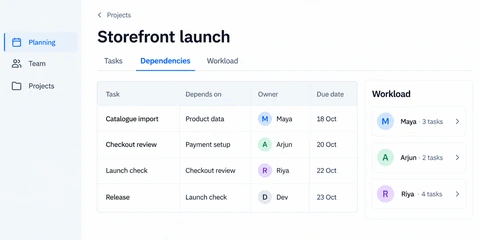
Project Planning Dashboard: Orbit
Task dependency relationships · Owner and deadline columns · Team workload summary.
Read the project case study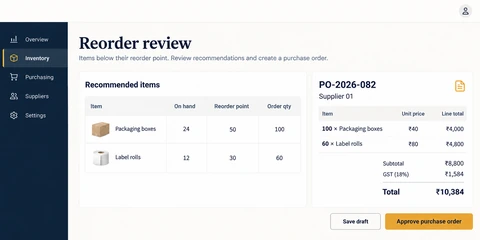
Inventory Management Software: Stockroom
Reorder thresholds and recommendations · Purchase-order line-item review · Separate draft and approval actions.
Read the project case study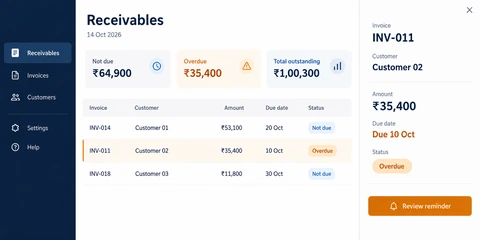
Invoice Management Software: Ledger
Outstanding and overdue summaries · Invoice list with date and status · Selected invoice detail and reminder review.
Read the project case studySee how a software development outsourcing engagement works.