
SEO, AEO & GEO: A Practical Website Improvement Plan
Learn where SEO, AEO and GEO overlap, how to prioritise website fixes and how to measure useful search visibility without ranking promises.
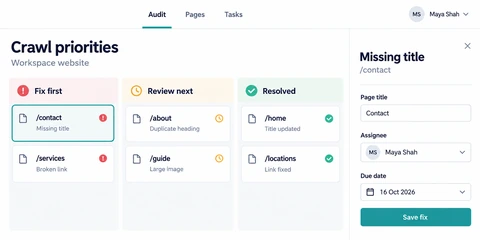
A growing business usually has a practical question: what should we improve first to bring more suitable enquiries? Start with a service page that explains who you help, what you deliver and how a project begins. Search visibility is only useful when a visitor can understand the offer and take the next step.
What do SEO, AEO and GEO mean?
| Focus | What it means | Useful work |
|---|---|---|
| SEO | Search engine optimization | Crawlable pages, clear structure and useful content. |
| AEO | Answer engine optimization | Clear responses to specific customer questions. |
| GEO | Generative engine optimization | Useful, attributable information for AI-assisted discovery. |
Google’s current guidance treats optimization for its generative AI search features as part of SEO. The fundamentals still matter: useful original content, accessible pages and a clear technical structure. Eligibility does not guarantee indexing or inclusion. Read Google’s guide to generative AI search.
Choose one customer journey to improve
For example, a manufacturer seeking a production dashboard needs to understand the problems it can solve, which systems it connects to, how implementation is scoped and what information to prepare. A page that answers those questions gives the buyer a more useful starting point than a long list of technologies.
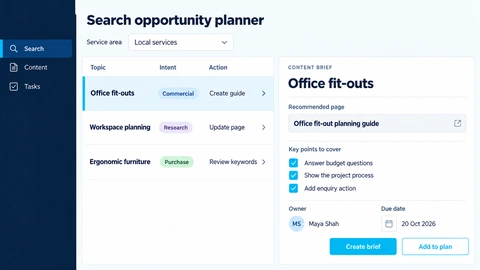
- Choose a priority service and define the type of enquiry you want.
- List the questions your sales team hears repeatedly.
- Review the current page on a phone: can a buyer find the answer and contact you?
- Add relevant examples, a clear process and a practical next step.
- Check that page titles, links and navigation describe the actual content.
Use structured data accurately
Structured data describes page content in a machine-readable format. Use applicable types and keep the markup consistent with what visitors can see. It does not guarantee a rich result or AI citation. See Google’s structured data introduction.
Agree what success looks like
- Record a baseline for the priority page before changing it.
- Track relevant search queries, landing-page visits and completed enquiries.
- Review enquiry quality: service fit, budget, location and readiness.
- Compare a meaningful period and account for seasonality before drawing conclusions.
At Cubusify, we bring the technical review, page improvements and measurement plan together. Explore our SEO, AEO and GEO service, then share your website and the services you want to grow.
Check public availability before rewriting content
Start with an unauthenticated visit to the intended production domain. A local preview or private review site is not the same as a public page. Check that important URLs return their own content with a successful response, that navigation links reach them, and that a genuinely missing page returns an appropriate error. A sitemap helps discovery; it cannot make an undeployed page exist.
- Check the public service URL, its canonical destination and any indexing directives.
- Confirm that important copy is available in the rendered page rather than only inside an image.
- Review hostname and redirect behaviour so visitors reach the intended production version.
- Use Search Console URL Inspection for indexing evidence; a browser request alone does not prove Google indexing.
Give each service page a distinct job
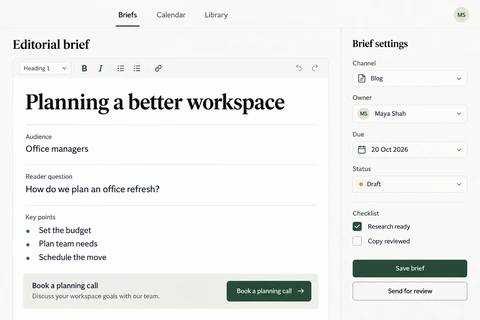
A parent service page should help buyers choose an approach. A specialist page should answer the next set of questions: what is included, which constraints matter, what information is needed and how implementation will be evaluated. Replacing only a title while repeating the parent’s benefits, process and FAQs provides little reason to read a second page.
| Page | Buyer question | Distinct information |
|---|---|---|
| Ecommerce development | Which store approach suits us? | Platform criteria, operating responsibilities and links to specialist services. |
| Shopify development | Can Shopify support our requirements? | Catalogue, theme and extension scope, checkout constraints, migration and recurring costs. |
| Ecommerce operations | How do we connect stock and order work? | Inventory authority, event mapping, reconciliation and staff exception handling. |
Those pages can coexist because their jobs differ. If two pages answer the same question with the same offer, consider a single stronger destination. Before removing an existing URL, review its queries and inbound links, preserve useful material and plan a redirect where appropriate.
Worked example: prioritising a CRM service page
Consider a hypothetical company whose CRM page says only that it builds scalable software. A buyer still cannot tell whether it handles sales pipelines, account permissions or spreadsheet migration. The first improvement is a scope section explaining those decisions, followed by a migration checklist and a question about configuring an existing CRM instead.
A relevant guide could then link to the service using “custom CRM development” where it explains software options. The service can link back to the guide for planning detail and forward to the enquiry form. This is a connected customer journey, not a reason to insert the same link into every paragraph.
Measure qualified discovery rather than audit scores
Record page and query clicks, impressions, click-through rate and average position where available. Separate brand searches from useful non-brand discovery and compare relevant markets and devices. A higher impression count is not sufficient if the enquiries are unrelated to the service.
Use completed, relevant enquiries as a business measure alongside search visibility. Compare similar periods and record changes to content, campaigns and availability so the result can be interpreted. Low traffic and long sales cycles limit what a short comparison can tell you.
Choose a practical first implementation batch
- Resolve access, broken URLs and indexing mistakes before commissioning more pages.
- Choose one commercially important service and a supporting guide with a real buyer question.
- Replace repeated copy with scope, tradeoffs and a useful worked example; keep claims attributable.
- Connect the guide, service and enquiry path with descriptive links.
- Review the baseline over a suitable period and decide the next improvement from the evidence.
For copy and metadata implementation on existing pages, explore on-page SEO and content optimisation. For the wider technical and measurement plan, explore SEO, AEO and GEO strategy.
Discuss your projectExplore our SEO, AEO and GEO strategy service for an audit and implementation plan.