How to Plan an MVP: Scope, Features & Validation
Plan a software MVP around one customer journey. Compare build options, prioritise features, set milestones and validate assumptions with real users.
MVP development is the practice of building the smallest working version of a product that can test your riskiest assumption with real users. A minimum viable product is not a rough demo and not a thinned-out copy of your full vision. It is a complete but narrow first version: one customer, one problem and one journey that works from start to finish.
To plan an MVP, name the customer and the problem, list your assumptions and pick the riskiest, sort features into must, should and could, and cut hard. Then define milestones as working outcomes and agree your success metrics before anyone writes code. The sections below take each step in turn, including when an MVP is the wrong tool.
What is a minimum viable product, and what is it not?
A minimum viable product is the smallest version of a product that delivers real value to a real user and teaches you something you could not learn by thinking. The word "minimum" limits the scope. The word "viable" sets the bar: someone must be able to complete a task and get a result they care about. Unlike a prototype, which may only show an idea, an MVP has to work for a user, even if it is narrow, manual in places and plain to look at.
The most common mistake is treating the MVP as version one of the full product, with every feature made thinner. That gives you a wide, shallow build that tests nothing. A better frame is a question. For example, "will clinic managers stop using a paper diary if booking takes two taps?" is a question an MVP can answer. "Will people like our platform?" is not.
How do you choose one customer, one problem and one journey?
Choose the customer who feels the problem most often and already works around it, whether with a spreadsheet, a stack of messages or a paid tool they dislike. Narrow beats broad. A product for "small businesses" cannot be tested, because their needs differ too much. A product for one type of team with one painful weekly task can be. The workaround you can see today is evidence that the problem is real.
Then write the journey as one sentence: "A customer can complete one task and see the result without help." If the sentence needs three "and" clauses, it is really three journeys. Pick the one that, if it worked, would make the customer say they would switch or pay. Everything else waits.
- Who exactly is the first user, and how will you reach ten of them?
- What do they do today instead, and what does it cost them in time or errors?
- What is the single action that proves they got value?
- What must be true before they can start, such as data, access or an account?
Which assumption should you test first?
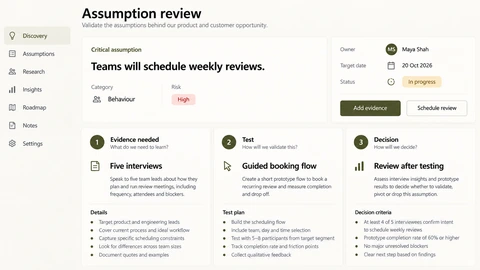
Test the assumption that would end the project if it were wrong and for which you have the least evidence. Every product rests on assumptions about whether people want it (desirability), whether you can build it (feasibility) and whether the business works (viability). Assumption mapping makes them visible, so your first weeks go to the one that matters most rather than the one that is easiest to build.
- List every assumption behind your idea, one per line, such as "managers will enter the data themselves" or "customers will pay monthly".
- Score each one for the damage if it is wrong and for how little evidence you have today.
- Circle the ones that score high on both. These are your riskiest assumptions.
- Pick one and design the smallest test that could prove it wrong.
- Decide in advance what result would make you continue, change direction or stop.
Often the riskiest assumption is not technical. It is "will they change their habit?" or "will they give us access to their data?" Test those with a conversation or a clickable mock-up first, and save engineering for assumptions only working software can test.
How do you scope MVP features with must, should and could?
Sort every candidate feature by one test: does the core journey fail without it? If yes, it is a must. If the journey works but is clumsier, it is a should. If it is merely nice to have, it is a could. Be strict: a real MVP scope has a short list of musts and a long list of coulds you will not touch.
| Bucket | Test to apply | Example features | Decision |
|---|---|---|---|
| Must | The journey fails without it | Choose a time slot, confirm the booking, see the confirmation | Build now |
| Should | The journey works but is clumsier without it | Email reminder, reschedule link | Build only if time remains after the musts |
| Could | Nice to have, and no user has asked for it yet | Calendar sync, loyalty points, custom themes | Leave out and note in a backlog |
| Not now | A real need, but risky or costly for a first test | Online payments, multiple locations, role permissions | Replace with a manual step or defer |
Cutting is where most MVPs are won or lost. Common things to remove from a first version include admin panels (use a database view or spreadsheet instead), user roles and permissions (start with one role), settings pages, multiple payment methods, polished onboarding, reporting suites and integrations with tools your first users do not rely on. Each can be replaced by a manual step.
Should you build, buy or use no-code for the first test?
Use the cheapest tool that can still answer your question. For a first test that may be a configured SaaS product, a no-code builder or a form connected to a spreadsheet. Custom code makes sense when the journey itself is the product, when a no-code tool cannot deliver the experience users need, or when the demand is already proven and you want to build it properly.
| Route | Best when | Watch out for |
|---|---|---|
| Build custom | The experience or logic is the product, or you need control over data and performance | Highest upfront effort, and it is easy to build more than the test needs |
| Buy or configure SaaS | A standard tool already covers most of the journey | Per-user costs and limits on how far you can change it |
| No-code or low-code | You need a working interface quickly to test demand | Limits on scale, performance and data portability; a rebuild may follow |
| Concierge or manual | You are unsure the customer wants the outcome at all | Does not scale and does not test technical feasibility |
None of these choices is permanent. Many good products began as a no-code test and were rebuilt once demand was proven. If you are weighing longer-term tooling rather than a quick test, our custom software team can help assess the criteria.
Can you fake the product first? The concierge and Wizard of Oz shortcut
Yes, and it is often the fastest route to learning. In a concierge MVP you deliver the outcome by hand and the customer knows it: you are the product. In a Wizard of Oz MVP the customer sees a working interface while people do the work behind it. Both test whether the outcome is wanted before you pay to automate it.
These shortcuts have limits. They do not prove the software can be built, they do not scale, and they can hide how much manual effort the real product will need. Be honest with users about how their data is handled. AI can play part of the wizard, for example by drafting replies, but a person should check the output before a customer relies on it.
How do you set milestones and success metrics before building?
Define milestones as working outcomes a person can try, not as lists of screens. "The login and dashboard pages are done" tells you little. "A new user can complete the booking journey on a phone and the clinic sees it" tells you the product works. Each milestone ends with a demo, so you can see progress, correct course early and stop if the evidence says so.
- A user can start and finish the core journey on a test account.
- The first real users can complete it without help from the team.
- The person on the other side, such as the admin or manager, can see and act on the result.
- Events are recorded so you can see where people drop out.
- A review compares what happened with the success metric you agreed.
Set success metrics before you build, while you are still neutral. Choose one primary metric tied to the journey, such as the share of started journeys that finish or the number of users who return unprompted. Write down the threshold that counts as success and what you will do if you miss it. Without this, every result can be explained away.
Instrumentation is how you get the data. At a minimum, record when a user starts the journey, each step they complete, where they leave and when they finish. Pair those numbers with short conversations, because analytics show what happened and people tell you why. Add tracking in the first milestone. A review of the journey with user experience design before you build often removes a whole round of rework. This is also how we work at Cubusify under Results as a Service: define the goal, deliver in milestones with demos and measure what changes.
How can AI help plan an MVP without replacing user conversations?
AI is useful for speed during planning and weak at the thing that matters most: telling you what real customers want. Use it to draft, summarise and prototype. Do not use it to decide. A language model can produce confident, plausible answers about customers who do not exist, and it will not warn you when it is wrong.
- Summarise and tag interview notes or transcripts, once participants have agreed and sensitive details are removed, then check the themes against the originals.
- Draft user stories, acceptance criteria and test cases that your team reviews and edits.
- Generate clickable prototypes and sample data so you can put something in front of users sooner.
- Scan public competitor material and documentation for questions worth asking, treating the output as leads to verify rather than facts.
What AI cannot do is replace talking to ten real people. Synthetic personas and AI-generated "customer feedback" are not evidence. Treat AI as a way to prepare better conversations and to build the test faster, never as the test itself.
When is an MVP the wrong tool?
An MVP is the wrong tool when the question is already answered or when "minimum" is not acceptable. If you are automating a well-understood internal process, the requirements are known and you should build the full solution in milestones. If the product handles payments, health records or other regulated data, security and compliance cannot be trimmed to fit a first test. And if you cannot reach any real users, building will not fix that. Sometimes the cheaper test is no software at all: a landing page or a manual pilot. If one of those can answer your riskiest assumption, do that first.
Worked example: a booking MVP scope brief
Imagine an appointment-based business testing whether customers will request a slot online instead of calling. The first release could show the service, collect a preferred time, let staff accept or decline, and show the resulting status. It should not imply instant confirmation if staff still control availability.
A staff-reviewed request flow can test interest before adding automatic scheduling, payments and several locations. The brief should still include permissions, duplicate submissions and a recovery path if confirmation fails. These are essential parts of the chosen task, not optional polish.
| Decision | Example |
|---|---|
| Customer | People booking one defined appointment service. |
| Assumption | They will complete an online request without a staff call. |
| Core journey | Choose a service, request a time and understand the accepted or declined status. |
| Out of scope initially | Payments, loyalty programmes and multi-location scheduling. |
| Evaluation | Agree a completion threshold before the pilot and pair usage records with short customer conversations. |
Bring that brief to an MVP development discussion. If the main uncertainty is usability, begin with UX research and prototyping. If the product is already running and needs ongoing feature delivery, SaaS engineering is a different engagement.
What to do next
This week, write your one-sentence journey, list your assumptions and circle the riskiest. Then sort your feature list into must, should and could, and challenge every must. Bring that page, plus a sketch or your current spreadsheet, to a conversation. Concrete examples make scope easier to agree.
If you would like a second pair of eyes, our MVP development work starts with exactly this: discovery, scope and a milestone plan. Cost and timeline depend on the scope, so the sensible first step is a short conversation. Talk to us about your MVP when you are ready.
See the workflow in our project work
Explore the screens and decisions behind related user journeys. Each case study explains its project context; the service choice for your own project follows your requirements.
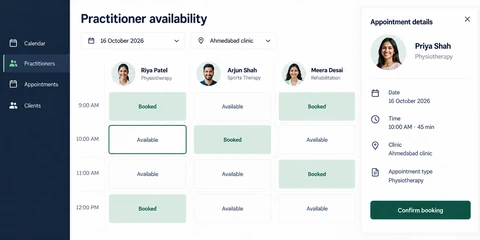
Appointment Booking App: Haven
Practitioner availability grid · Date and clinic selection · Appointment review before confirmation.
Read the project case study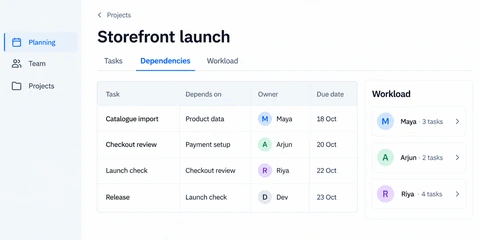
Project Planning Dashboard: Orbit
Task dependency relationships · Owner and deadline columns · Team workload summary.
Read the project case studyExplore MVP development services for a focused first release.