Enterprise reference architecture
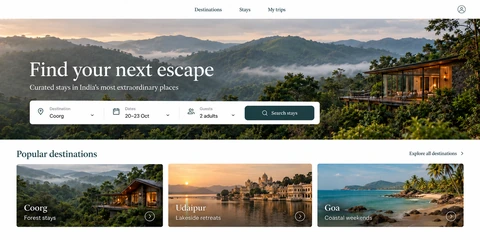
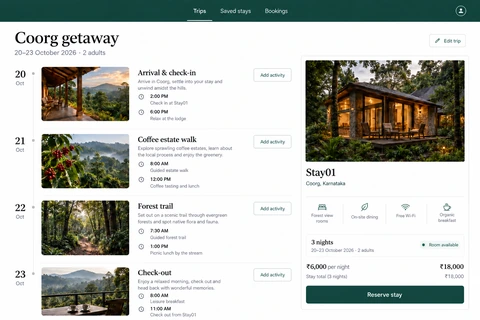
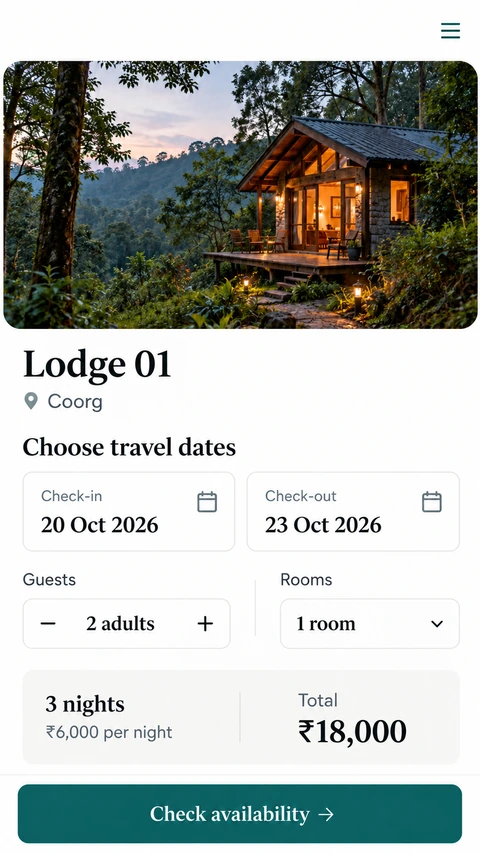
A proposed engineering design for this workflow. The enterprise scenario and stack below are illustrative architecture choices; they are separate from the confirmed project screens.
The enterprise scenario
A travel operator combines several accommodation suppliers and curated itineraries, while staff handle changes, cancellations and uncertain supplier responses.
Architecture objective: Make the distinction between a displayed option, a temporary hold and a confirmed reservation explicit throughout the booking lifecycle.
Proposed technology stack and rationale
Experience
Next.js, React and TypeScript
Render searchable destination content while keeping reservation commands behind authenticated server endpoints.
Booking domain
Java, Spring Boot and typed provider adapters
Separate itinerary planning from inventory holds, supplier commitments and cancellation rules.
System of record
PostgreSQL with transactional reservation state
Use explicit states, stable booking references and constrained transitions instead of inferring confirmation from an HTTP timeout.
Long-running coordination
Temporal workflows and idempotent activities
Coordinate supplier holds, expiration and compensation when a multi-step reservation cannot complete.
Discovery and observability
Elasticsearch, Redis, Prometheus and Grafana
Treat search and cached availability as read models with freshness indicators, not booking authority.
Technical challenges and design approach
1Ambiguous supplier confirmation
A request may succeed remotely even if its response is lost. Record an uncertain state and reconcile by booking reference before attempting the side effect again.
Time zones and itinerary boundaries
A booking date and an instant are different values. Preserve the supplier’s local date rules and explicit IANA time-zone context.
Partially completed reservations
One supplier can confirm while another fails. Define compensation eligibility, expiry and staff escalation instead of assuming a cross-provider transaction.
How the proposed workflow fits together
- The traveller prepares an itinerary from searchable offers with displayed freshness.
- A booking command validates the requested dates and party against authoritative supplier rules.
- The workflow records holds and correlation identifiers before continuing to the next dependency.
- Successful supplier confirmation advances the reservation state and prepares the customer notification.
- Failures trigger an eligible compensation or an explicit operations-review task with the full history.
Acceptance and failure-path checks
- A repeated booking command returns the original reservation reference.
- Expired holds cannot be presented as confirmed availability.
- Provider timeouts, delayed callbacks and cancellation failures are included in the test suite.
- Operations staff can distinguish failed, pending and uncertain reservations without reading application logs.
The tradeoff
Introduce a workflow engine when reservation coordination is genuinely long-running and operationally important. A simpler transactional booking service is easier to run for a single supplier and a short synchronous flow.
Architecture references: Spring Boot documentation, Temporal task execution and AWS reliability guidance. These describe engineering patterns, rather than certify this project’s implementation.