
An order-linked message queue
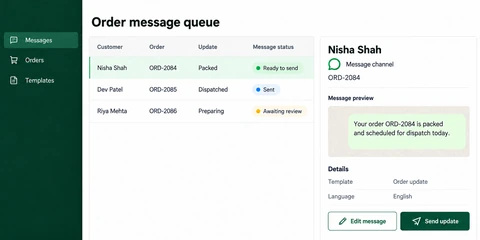
Customer, order reference, order update and message status appear together. Ready to send, Sent and Awaiting review are distinct states, so the queue represents the communication workflow as well as the order status.
A customer-communications workspace connecting order status, message templates and a reviewable outbound message queue.
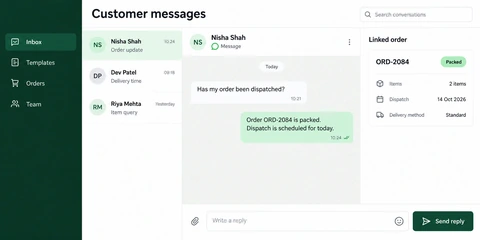
The project’s message queue links each update to a customer and order. A side panel provides the selected message preview, template and language context. The layout connects communication with the operational event behind it.
Customer, order reference, order update and message status appear together. Ready to send, Sent and Awaiting review are distinct states, so the queue represents the communication workflow as well as the order status.
The selected message is presented in a recognisable channel preview with its order context. Template and language details remain visible below it, supporting a deliberate review rather than an unexplained send button.
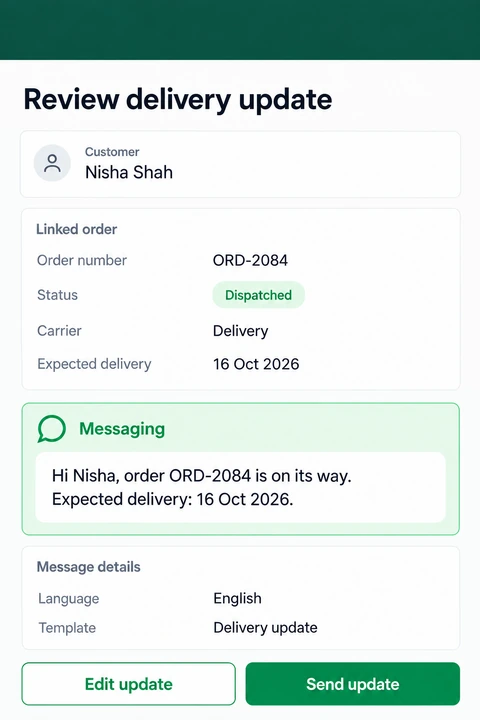
Edit template and Send update are separate actions. This makes the difference between preparing a message and transmitting it clear. The mobile views show the related customer-communication experience.
Connect a customer message to its source event and make send state explicit. An order being packed and a customer update being sent are different facts and should remain distinguishable.
Explore the relevant development service for this project workflow to discuss your requirements.
A proposed engineering design for this workflow. The enterprise scenario and stack below are illustrative architecture choices; they are separate from the confirmed project screens.
An operations team sends order updates through several communication providers while maintaining customer preferences, staff review and provider delivery history.
Architecture objective: Separate an operational order event from the message prepared, authorised and delivered in response to it.
React and TypeScript
Keep order context, template choice, preview and send state together for the reviewer.
Node.js with explicit message-state transitions and n8n workflows
Model preparation, approval, provider acceptance, delivery failure and suppression as distinct states.
PostgreSQL with an outbox and stable command identifiers
Retain the source event, template version and intended recipient for each communication.
Twilio and SendGrid adapters with signed webhooks on a BullMQ queue
Respect provider limits, validate callbacks and reconcile delayed or uncertain transmission outcomes.
OpenAI API for draft wording, reviewer approval and Grafana monitoring
The model only proposes wording; a reviewer approves and sending stays a separate, permissioned step. Monitor backlog and provider failure patterns.
An order being dispatched does not mean its update was sent. Keep operational and communication states independent and linked by reference.
Provider callbacks can repeat and arrive out of order. Validate signatures and apply explicit transition rules rather than accepting every callback as the newest truth.
A preference or suppression rule can change after drafting. Recheck eligibility at the authorised send boundary and retain the decision.
Use provider-specific adapters behind a small common contract. Forcing every channel into identical delivery semantics hides meaningful differences in templates, limits and confirmation behaviour.
Architecture references: n8n documentation and Twilio webhook security. These describe engineering patterns, rather than certify this project’s implementation.
Use the project to discuss the task and the information your users need. Then define the integrations, access rules and release scope for your own business.
Bring your idea. We’ll help you find a clear way forward.