Enterprise reference architecture
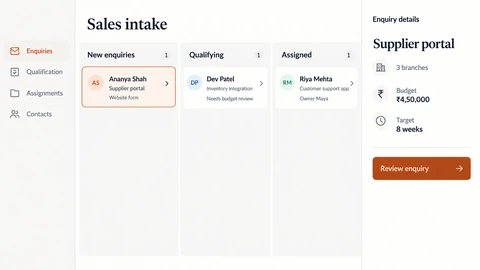
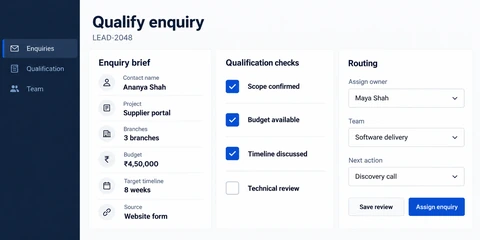
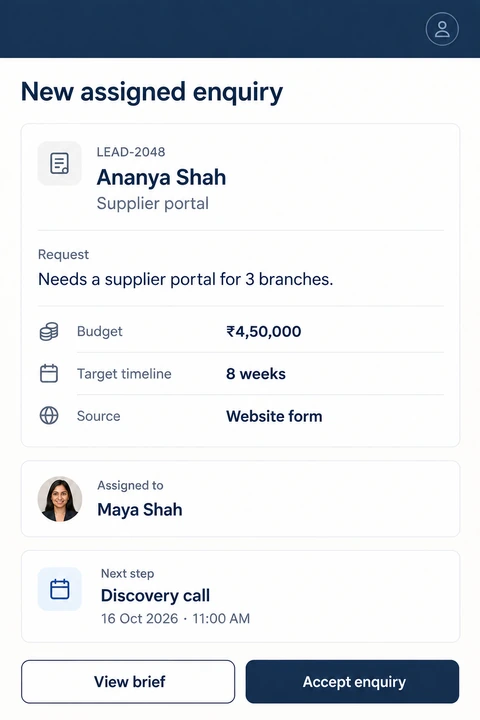
A proposed engineering design for this workflow. The enterprise scenario and stack below are illustrative architecture choices; they are separate from the confirmed project screens.
The enterprise scenario
An enterprise delivery organisation routes inbound enquiries across business units, with qualification reviews, technical assessment and CRM handoffs that may take several days.
Architecture objective: Make the qualification decision reproducible and the routing action recoverable, while allowing the team to explain why a record reached a particular owner.
Proposed technology stack and rationale
Qualification experience
React and TypeScript with schema-driven forms
Collect a structured brief and expose incomplete fields before staff approve the handoff.
Business process
Java, Spring Boot and Camunda (BPMN workflow engine)
Represent qualification, specialist review and reassignment as explicit human and system tasks.
Record and decision model
PostgreSQL with versioned routing rules
Store the enquiry, decision inputs, rule version and accepted assignment as related records.
AI extraction and CRM connections
OpenAI API for structured extraction; HubSpot or Salesforce adapters with an outbox
The model summarises the enquiry and proposes facts for staff review while routing stays rule-based; use stable external identifiers and reconciliation when the CRM cannot confirm a write.
Identity and audit
OIDC, business-unit permissions and audit logging
Limit record access and preserve who reviewed, changed or approved the qualification.
Technical challenges and design approach
1Unexplained routing decisions
A score alone does not explain ownership. Store the input facts and rule version and show the reviewer the applicable routing reason.
Long-running human review
A qualification can wait for technical input while staff or rules change. Define expiry, reassignment and resumption behaviour instead of relying on an open browser session.
CRM handoff uncertainty
A timed-out create request may still succeed. Reconcile using the enquiry’s stable external reference before sending another create operation.
How the proposed workflow fits together
- An inbound adapter validates the source and deduplicates the enquiry.
- Qualification captures structured facts and identifies the missing specialist review.
- A reviewer approves the routing decision against the current record and rule version.
- The workflow records the assignment and a durable CRM handoff task.
- The adapter confirms or reconciles the external record and exposes unresolved work to the assigned owner.
Acceptance and failure-path checks
- Repeated intake events resolve to one logical enquiry.
- Every accepted assignment can be traced to its facts, rule version and reviewer.
- A business-unit user cannot access an unrelated enquiry by guessing its reference.
- Rule changes and reassignment preserve earlier decisions rather than rewriting their history.
The tradeoff
Use a workflow engine when handoffs and human tasks need durable coordination. Deterministic routing rules remain preferable to AI classification where the decision is already clearly defined.
Architecture references: Camunda documentation and OpenAI structured outputs. These describe engineering patterns, rather than certify this project’s implementation.