
The original request stays visible
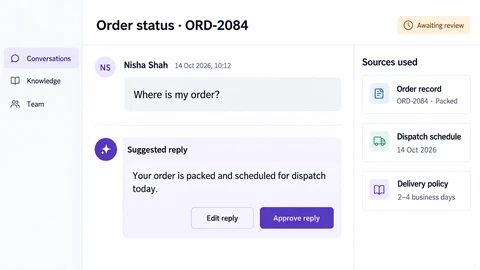
The customer’s question remains above the proposed response. That lets the reviewer judge whether the draft addresses the actual request instead of assessing a summary without its source conversation.
An AI-assisted support workspace bringing a customer question, suggested response and supporting source records into one review screen.
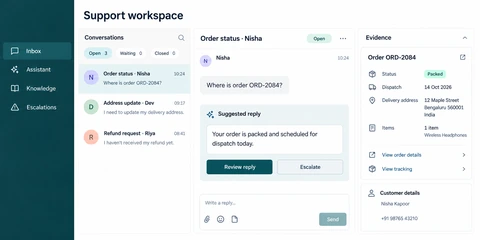
The project’s support screen centres on an order-status question. A suggested reply appears beside the order record, dispatch schedule and delivery policy used as context. The interface keeps the person reviewing the response in control of the next action.
The customer’s question remains above the proposed response. That lets the reviewer judge whether the draft addresses the actual request instead of assessing a summary without its source conversation.
A Sources used panel identifies the records relevant to the response. The order, dispatch and policy context are visible at the point of review, giving the reader something concrete to compare with the draft.
The screen labels the response as suggested and the request as awaiting review. Edit reply and Approve reply express different decisions. The project demonstrates the review workflow; a screenshot does not measure the assistant’s accuracy.
AI assistance is easier to evaluate when the original question, proposed answer and supporting context are visible together. Human review should be represented as a real workflow step.
Explore the relevant development service for this project workflow to discuss your requirements.
A proposed engineering design for this workflow. The enterprise scenario and stack below are illustrative architecture choices; they are separate from the confirmed project screens.
An enterprise support organisation wants an assistant that uses internal policies and account context while preserving document permissions and human authority over consequential replies.
Architecture objective: Make retrieval, generated text and approved actions separately inspectable so a fluent response is never treated as evidence that the answer or permission is correct.
Next.js, React and TypeScript
Present the original request, source context, draft and approval action in one review journey.
Python, FastAPI, LangChain and a model gateway to OpenAI or Anthropic models
Version prompts and retrieval settings, evaluate representative questions and restrict which providers receive which data.
PostgreSQL with pgvector, embedding models and document-level access metadata
Apply tenant and document permissions before retrieval and re-check protected source access.
LangGraph approval steps and scoped service credentials
Keep tool calls behind explicit authorisation and make external write operations idempotent and reviewable.
Langfuse traces with redaction and an evaluation dataset
Track unsupported responses and source coverage without turning logs into a second uncontrolled knowledge store.
A relevant passage may still be forbidden to the user. Filter candidate documents at the access boundary and test isolation with adversarial account combinations.
Retrieved content is untrusted input. Separate instructions from source material, constrain available tools and require approval for actions beyond drafting.
A citation can point to a document without supporting the statement. Evaluate support at the answer level and provide abstention and escalation paths.
A small, well-governed retrieval system is a better first step than an autonomous agent with broad tools. Expand autonomy only after evidence demonstrates acceptable behaviour for a defined task.
Architecture references: LangChain documentation, LangGraph documentation and pgvector. These describe engineering patterns, rather than certify this project’s implementation.
Use the project to discuss the task and the information your users need. Then define the integrations, access rules and release scope for your own business.
Bring your idea. We’ll help you find a clear way forward.