Relevant, practical answers
Get clear responses based on your business information, written for real work.
Build a business knowledge assistant that searches approved information, explains its sources and gives people a way to review or escalate uncertain answers.
Discuss your project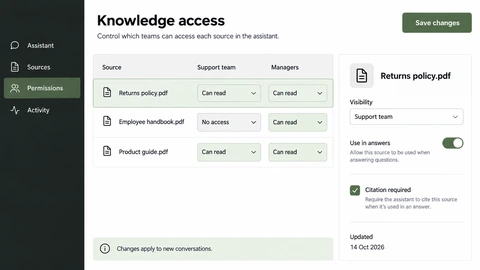
Get clear responses based on your business information, written for real work.
Helps people find information, solve problems and move work forward.
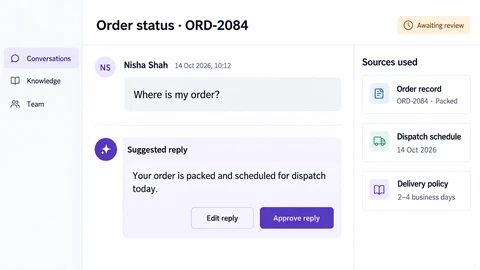
Suggestions are editable and consequential actions are human-reviewed.
A useful assistant needs more than a model connection. Its scope includes the documents it may retrieve, the permissions it must respect and the questions it should decline. Begin with a bounded knowledge set and realistic questions from the people who will use it.
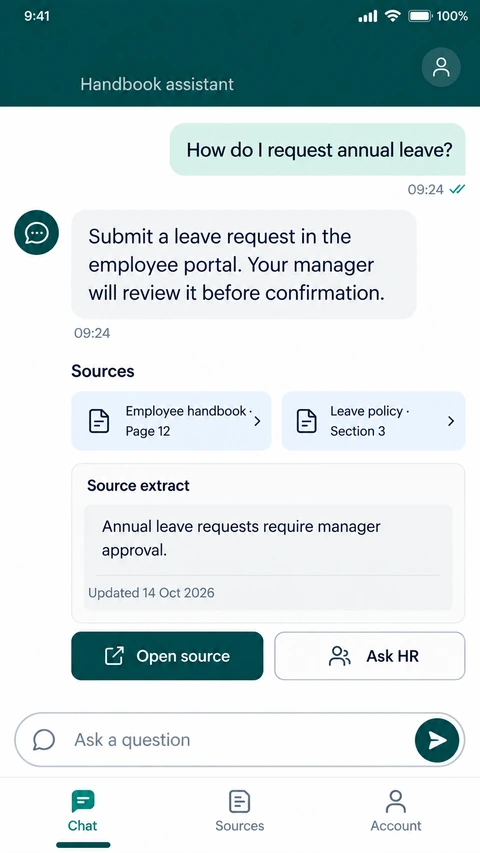
Answer questions using your internal policies, guides and team knowledge.
Find and summarise information across your files, from simple questions to detailed research.
Help your team with everyday tasks, like drafting emails, explaining processes or preparing updates.
Keep people in control, with editable AI suggestions and human approval for important actions.
For example, an internal policy assistant could return a draft explanation with the relevant source passage. That is a proposed workflow, not a claim that AI answers are always correct.
Identify document owners, update frequency and access rules. Remove obsolete material and decide which information must not be sent to external services.
Include ambiguous questions, missing answers and conflicting sources. Review whether responses are supported, correctly attributed and appropriate for the user’s permissions.
Provide uncertainty messages and a human escalation route. Assign ownership for source updates, feedback and recurring evaluation.
Explore the interface, then open any image at its original resolution.
Straightforward answers to common questions about AI assistants.
Not necessarily. Retrieval from approved sources may be a better starting point. Model training, retrieval and integrations solve different problems.
Access boundaries must be part of retrieval and testing, not merely hidden in the interface. The design depends on the source system’s permission model.
Use representative questions and agreed references. Review supported answers, missing answers, source accuracy and unsafe disclosures rather than relying on fluent wording.
Agree the important success and failure paths before development. These proposed checks help turn the service description into a reviewable delivery brief.
Explore the screens and decisions behind related user journeys. Each case study explains its project context; the service choice for your own project follows your requirements.
Talk to our team about how AI assistants can support your goals.