
Custom Ecommerce
Development
Build a tailored commerce workflow when essential product, pricing or ordering rules cannot be handled sensibly by a standard store.
Discuss your project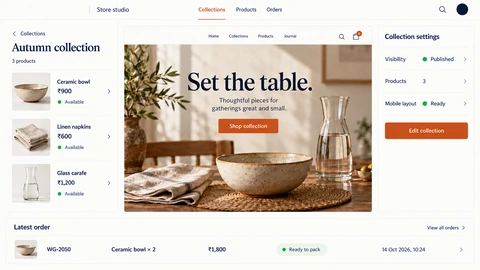
Custom ecommerce scope
Custom commerce adds flexibility and operational responsibility. Before building, compare a conventional platform with focused extensions against a custom solution for the specific requirement that differentiates the business.
Specialised buying rules
Model configurations, customer-specific pricing, quote requests or approval paths that define the purchase.
Order and stock systems
Establish order states, inventory authority and reconciliation between the storefront and fulfilment tools.
Commerce operations
Plan administration, payment-provider integration, refunds and monitoring alongside the customer screens.
Planning custom ecommerce
- 1
Validate the exceptional requirement
Prototype the configuration, B2B approval or pricing rule that makes a standard platform unsuitable.
- 2
Connect the order lifecycle
Follow order creation through payment status, allocation, fulfilment and cancellation, including duplicate events.
- 3
Test recovery before launch
Rehearse failed payments, stale stock and interrupted provider connections with clear staff recovery procedures.
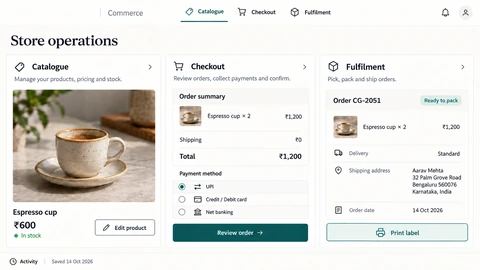
See the details.
Across every screen.
Explore the interface, then open any image at its original resolution.
Desktop experience
1 / 1Custom ecommerce
Scope, tradeoffs and preparation for your project.
Should we build our own payment processing?
Use appropriate payment providers and their supported integration patterns. A custom store does not mean inventing a payment infrastructure.
When is headless commerce appropriate?
It can help when distinct frontends need a shared commerce backend. It also adds integration and deployment responsibilities that should justify the added complexity.
How do you estimate custom ecommerce?
Product rules, order states, customer roles, integrations and migration determine scope. A catalogue sample and fulfilment walkthrough are useful starting points.
How we would validate this scope
Agree the important success and failure paths before development. These proposed checks help turn the service description into a reviewable delivery brief.
- A submitted order is revalidated against authoritative price, stock and customer rules.
- Duplicate provider callbacks cannot repeat an order transition or refund action.
- Order, payment and fulfilment states remain separately inspectable.
- Failure tests include unavailable providers, stale catalogue data and interrupted checkout.
See the workflow in our project work
Explore the screens and decisions behind related user journeys. Each case study explains its project context; the service choice for your own project follows your requirements.

Discuss your custom ecommerce project.
Share your requirements so we can agree a focused scope, dependencies and the next useful step.