
CI/CD Pipeline
Development
Connect code changes, meaningful checks and deployment steps so releases follow a visible, repeatable process.
Discuss your project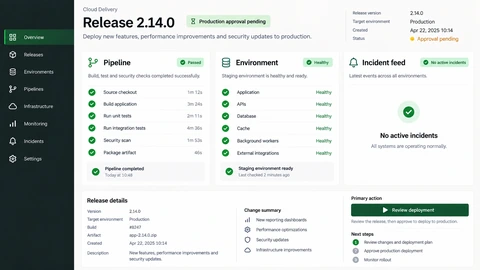
CI/CD pipelines scope
A pipeline should make a release easier to understand and recover. Its checks, permissions and approval gates must reflect the risk of the application rather than adding steps without a purpose.
Build and verification
Define reproducible builds, dependency handling and checks that reveal meaningful regressions.
Environment promotion
Separate credentials and configuration, with explicit approval where a production change requires review.
Release diagnosis
Provide logs, artifact references and a documented response when a deployment fails.
Planning CI/CD pipelines
- 1
Map the manual release
Record commands, accounts and undocumented dependencies in the current process. Identify steps that rely on one person.
- 2
Automate a staging deployment
Validate builds and application checks in a representative environment before enabling production promotion.
- 3
Exercise failed-release handling
Test missing configuration, failed checks and database-change behaviour so the team knows when to stop or recover.
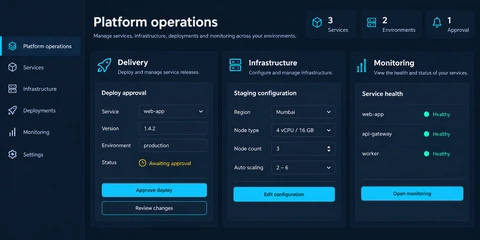
See the details.
Across every screen.
Explore the interface, then open any image at its original resolution.
Desktop experience
1 / 1CI/CD pipelines
Scope, tradeoffs and preparation for your project.
Does continuous delivery mean automatic production releases?
No. A pipeline can prepare a verified release while retaining an explicit production approval.
Can you use our existing repository tools?
The design should start from the current repository, runner permissions and hosting interfaces rather than force an unnecessary tool migration.
Can every deployment be rolled back?
Not automatically. Database and external-system changes need specific compatibility or recovery strategies.
How we would validate this scope
Agree the important success and failure paths before development. These proposed checks help turn the service description into a reviewable delivery brief.
- A failed required check prevents the intended promotion step.
- Build artifacts can be traced to their source revision and environment configuration.
- Production credentials are not exposed to an untrusted change or preview job.
- Database changes have an explicit compatibility or recovery strategy.
Discuss your CI/CD pipelines project.
Share your requirements so we can agree a focused scope, dependencies and the next useful step.